Explore the Technologies
T0 Hex is produced with TechnoFusion — our moldless, digitally controlled additive-composite process, built from zero, in-house in the EU.

T0 Hex is our flagship. It’s the first product made with TechnoFusion, the moldless production method we built to make equipment to a measured number instead of an average. Every T0 Hex is the proof it works: made without a mold, measured on its own, shipped with its own numbers. Series Zero is where that proof starts.
No mold. No model years.
A molded racket stays fixed to its tool until a new tool is cut. T0 Hex has no mold, so when we improve how it’s built or finished, the next unit gets it.
Unit to unit, we improve how it’s built — never the spec. Series to series, the spec can move, and Series Zero owners hear first.
- Hard molds
- Fixed tooling geometry
- Batch-averaged shapes
- Hours of manual labor and its variation
- Per-unit configuration at production time
- Tighter process control and QC
- Structures and material distribution conventional molding can’t produce
- A more sustainable build — no molds, less hand labor, far less waste
The advantage isn’t one detail. It’s a hard-to-copy system — construction, process, parameters, measurement and IP, together.
The technologies.
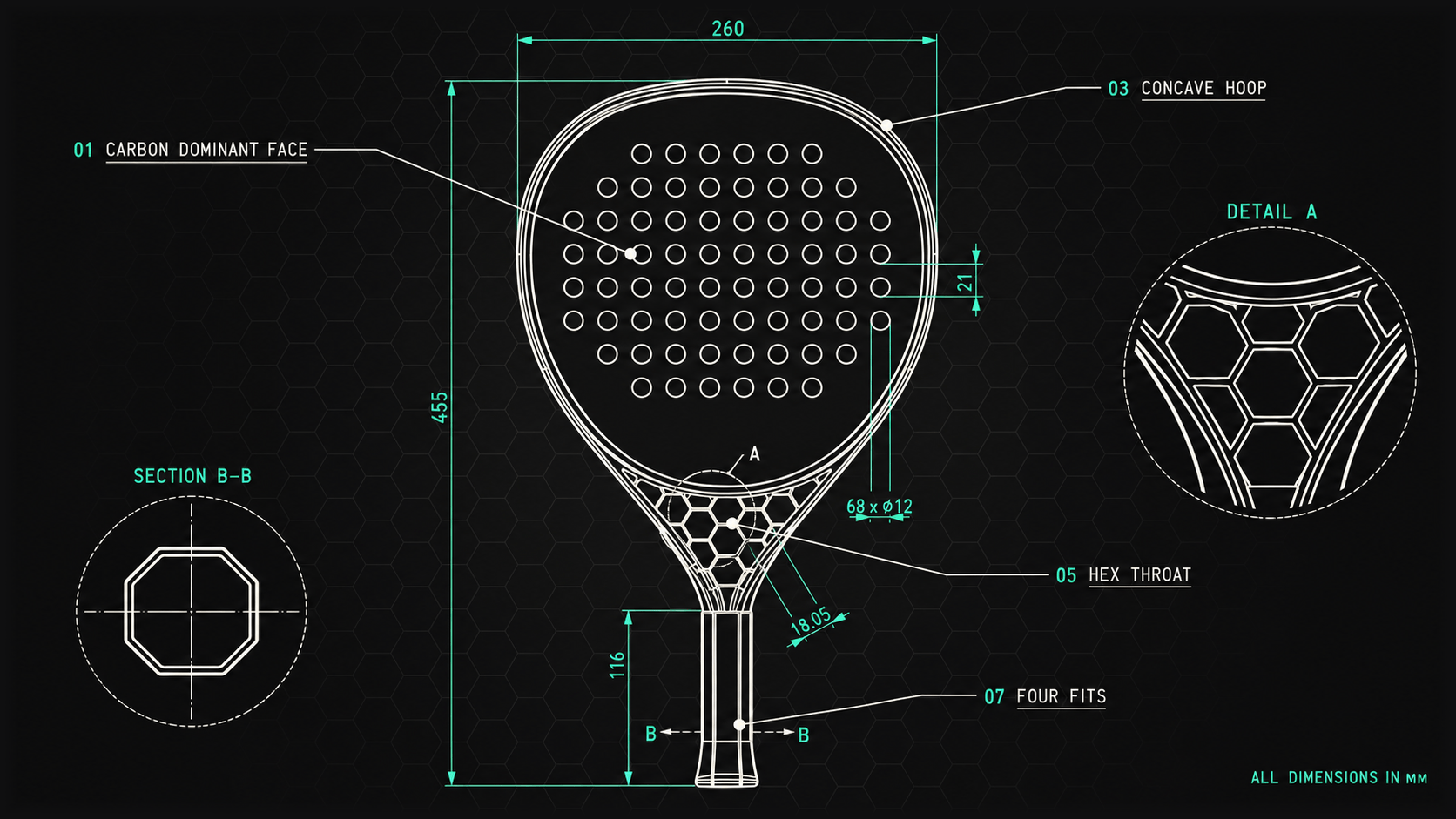
CARBON DOMINANT FACE
Stiff, light, responsive.
The striking face is built carbon-first: high fiber density, resin held to what the structure needs. The face is stiff and light, so it returns energy rather than absorbing it — resin adds mass without adding response. Mass saved here is not lost; it goes where it does more work.
COUPLED CORE
Core and face, engineered as one.
Core and face are designed together as one structure, not chosen apart and bonded afterwards. The pairing exists to exploit what TechnoFusion allows: core density matched to face stiffness, so structural mass is placed on purpose rather than inherited from a mold — dense and uniform where the ball lands, and free to be moved outward where the face does not need it.
CONCAVE HOOP
A bigger face inside the same width.
The hoop section is drawn inward instead of bulging outward. Inside the same legal width, less of the frame is dead perimeter and more of the face works — the effective sweet spot grows without growing the racket.
SECOND GRIP
A control point for your other hand.
The throat is shaped concave on purpose, giving your non-dominant hand a designed place to hold and guide the head. In padel there is rarely time for a full swing — that hand steadies the frame and sets the shot, and it counts most on the backhand and on fast defensive returns.
HEX THROAT
Load paths, designed in.
A conventional throat is one stiff junction. The hex grid replaces it with defined load paths, controlling how force and vibration travel into the handle. It also does something a solid throat can’t: catch the ball on the throat and the grid still returns a controlled shot, instead of a random rebound.
DWELL ZONE
Flex placed, not left to chance.
The hex throat and the coupled core are tuned to flex in defined zones, so the face loads and releases through the shot rather than snapping back instantly. The design intent is a longer moment of contact — more time for the face to load and return energy, and more time for you to work the ball.
FOUR FITS
Shape and end, built in.
Two choices — the shape of the grip and the end of the handle — make four fits: INDEX, DRIVE, GLIDE, SWEEP. Built into the racket at production time, not corrected later with stacked overgrips.
ZERO DRIFT
Numbers that hold, unit to unit.
Mass is built to the target you set. Swingweight — how heavy the racket feels when you swing it — is what decides how a racket plays, and most makers let it drift from unit to unit. We build and measure every racket ourselves, so the next one feels like the one you loved.
Carbon Dominant Face
Proprietary carbon face laminate
Coupled Core
Core and face, matched as one system
Everything you feel at contact — how the ball loads in, how fast it leaves, how clean the touch is — is decided by the pairing of the foam core and the carbon face stack. Ours is a proprietary pairing: core and plies selected and tuned together for energy return, consistency, and sweet spot. TechnoFusion is what makes the pairing possible, and what molding can’t reproduce.
The principles are open. The recipe stays ours.
| What you feel | What drives it |
|---|---|
| Energy return | High fiber density, low resin mass — the fiber does the work; excess resin adds mass, not response. |
| Consistency | A dense, uniform core under the whole face — the same response, shot after shot. |
| Sweet spot | Structural mass concentrated in the hitting zone — fiber working where the ball actually lands. |

Concave Hoop
Concave frame cross-section.

Second Grip
The concave throat
The throat — the part that joins the head to the handle, which padel coaches call the “heart” of the racket — is where your non-dominant hand rests. We shaped it concave on purpose: it bridges head and handle and gives your free hand a secure, ergonomic place to hold and guide the racket.
Your non-dominant hand on the throat controls the racket head — it sets your shoulder turn, steadies the frame, and helps you play a compact, controlled shot.

Hex Throat
Hex grid load paths
Load-path control is the feel: engineered and repeatable, designed in rather than left to the layup.
Dwell Zone
Tuned flex zones
A handle that fits your hand.


Flat-sided grip with a flared end that locks into your palm — extra leverage on smashes and overheads.
Rounder grip with a flared end — fast grip changes plus palm leverage on the overhead.

Zero Drift
Mass and swingweight, held unit to unit
Weight is how heavy the racket is on the scale. Two rackets can weigh the same and swing completely differently.
Lighter to swing = faster and easier to react; heavier to swing = more power and more stability on contact.
Measured · ± 1 pt
What you feel in a racket is structure, material selection, material distribution, mass and swingweight. We control all five. We measure two on every unit.
Tennis handle parts and dampers are available in our shop. Visit the shop →